
Single-phase or three-phase sounds like a technical detail best left to an electrician — until it’s time to buy an EV charger. Then, it determines whether your car can charge at 7.4, 11, or 22 kW — and whether paying more for a powerful wallbox will actually make charging any faster.
The catch is that the charger’s headline power rating tells only part of the story. Actual charging speed is limited by the home’s electrical supply, the EV’s onboard charger, and the charging equipment itself. Efficiency matters too: slower charging can keep the car’s electronics running longer, increasing the share of electricity lost during a charging session.
That makes the choice less about whether three-phase is simply “better” and more about which setup fits the car and property. This guide compares single-phase and three-phase EV charging by speed, efficiency, compatibility, and cost — including how to identify the available supply and when three-phase charging is genuinely worth it.
Single-Phase vs Three-Phase EV Charging: Key Differences Compared
Single-phase charging uses one live conductor at 230 V and tops out at 7.4 kW (32 A), while three-phase charging uses three live conductors at 400 V and delivers 11 kW (16 A) or 22 kW (32 A). Three-phase charging is therefore up to three times faster on AC.
|
Feature |
Single-Phase |
Three-Phase |
|
Voltage |
230 V |
400 V (3×230 V) |
|
Live conductors |
1 |
3 |
|
Max AC power |
7.4 kW |
11 or 22 kW |
|
~60 kWh battery |
8–9 hours |
3–6 hours |
|
Typical use |
Homes |
Homes, commercial, fleets |
However, actual charging power is always limited by the lowest of three ceilings: the car's onboard charger, the station, and the cable rating (Schneider Electric, Electrical Installation Guide). For example, a 40 kWh car with a 6.6 kW onboard charger still needs 6.5 hours to charge on an 11 kW station.
Mismatches are harmless. A single-phase car on a three-phase charger draws power from only one phase, capped at roughly 7.4 kW. Likewise, a three-phase car on a single-phase charger simply charges at single-phase speed. Nothing breaks; the weakest link sets the pace.
No onboard charger exceeds 22 kW, which is the AC charging ceiling. DC fast charging goes far higher because it bypasses the onboard charger entirely. Since 22 kW requires a three-phase supply, consider 22 kW EV home chargers only if your property has one.

Is 240V Single-Phase or Three-Phase? How to Identify Your Home Supply
A reading of 230–240 V between live and neutral indicates a single-phase supply, while a three-phase supply measures 400 V between any two phases (or 3 × 230 V phase-to-neutral).
You can identify your supply type without instruments using three quick checks:
- Electricity meter: Three-phase meters typically state 3 × 230/400 V on the label.
- Main fuses: One fuse means single-phase; three fuses mean three-phase.
- Main switch wiring: Three thick live conductors entering the switch confirm a three-phase supply.
If anything is unclear, ask a qualified electrician. German standard DIN VDE 0100 permits up to 4% loss in household wiring, so ADAC recommends having older installations inspected before relying on any home charging setup.
Regional patterns matter too. Most Northern and Central European homes have access to three-phase supplies, whereas UK homes are predominantly single-phase, which caps home AC charging at 7.4 kW.

Is a 7kW EV Charger Single-Phase or Three-Phase?
A 7 kW charger is single-phase. Its rating, precisely 7.4 kW, represents the maximum single-phase output: 230 V × 32 A ÷ 1,000.
This makes 7.4 kW the standard home wallbox rating in single-phase countries such as the UK. It fully recharges a typical 60 kWh EV overnight in roughly 8–9 hours, which covers most daily driving needs.
By contrast, 11 kW and 22 kW chargers are three-phase by definition, running at 3 × 230 V and drawing 16 A and 32 A, respectively.
Germany treats 7.4 kW differently. A single-phase wallbox at that rating creates 7.4 kVA of phase unbalance, exceeding the 4.6 kVA limit set by German grid connection rules (VDE-AR-N 4100 and the DSOs' TABs). Consequently, German installers typically use three-phase wallboxes, while UK installers fit single-phase units without issue.
Can You Use a Three-Phase EV Cable on a Single-Phase Supply?
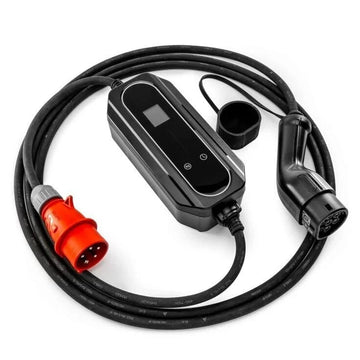
Yes, a three-phase Type 2 cable is fully backward-compatible: when connected to a single-phase charger, it simply carries one phase, and charging runs at single-phase speed. Nothing needs to be configured, and nothing gets damaged.
The reason lies in the connector design. The Type 2 connector (IEC 62196-2) supports both single-phase operation up to 16 A and three-phase operation up to 63 A. Additionally, a PP resistor inside the cable signals its current rating to both the car and the station, so each side automatically stays within safe limits.
This makes a three-phase cable the future-proof choice. It costs slightly more but works everywhere, including at public 11 and 22 kW stations. A Mennekes Type 2 cable covers every AC charging scenario.
The reverse does not hold. A single-phase-only cable or a Type 1 (SAE J1772) connector physically cannot carry three phases, capping charging at 7.4 kW even on a 22 kW station.
Charging Losses: Why Does Faster Three-Phase Charging Waste Less Electricity?
An ADAC study found that charging from a 2.3 kW household socket wasted 12.7–24.2% of the electricity drawn, while the same cars charging from an 11 or 22 kW wallbox lost only 5.1–7.0%, roughly half as much (measurements by Wolfgang Rudschies, ADAC Technik Zentrum).
The cause lies in the car itself. Control electronics consume 100–300 watts throughout the charging session, regardless of charging speed. Because a single-phase session runs several times longer, that fixed overhead accumulates into a far larger share of the total energy consumed.
The per-car figures are striking. The Mercedes CLA 350 EQ lost 24.2% at a household socket but only 6.9% on an 11 kW wallbox; the Tesla Model Y’s losses dropped from 12.7% to 6.1%.
Consequently, a proper wallbox can recover part of its purchase price through reduced charging losses alone. Before relying on a domestic outlet, read our analysis of charging from a 13-amp socket
How to Choose the Right Charging Setup for Your EV and Home
Match three factors before buying anything:
- Your car's onboard AC charger: Check the spec sheet, as many EVs accept only 7.4 or 11 kW.
- Your home supply type: Single-phase or three-phase.
- Installation cost and future-proofing.
The decision rules are simple. On a single-phase supply, a 7.4 kW wallbox is the maximum and covers typical overnight charging needs. With three-phase power available, an 11 kW wallbox is the sweet spot, while 22 kW suits high-mileage drivers, two-EV households, or businesses.
A three-phase supply upgrade adds cost. However, fitting a three-phase-capable wallbox during electrical work avoids paying twice later. As of 2026, EU building rules (EPBD, Directive 2024/1275) require pre-cabling for EV charging in new residential buildings with more than three parking spaces.
One real-world caveat: lithium-ion batteries charge fastest at 20–30 °C, so winter charging sessions are slower than the arithmetic suggests, regardless of phase count.
For model comparisons, see our guide to choosing the best EV charger or browse the full range o fhome charging stations.

Single-Phase vs Three-Phase EV Charging: FAQ
Is Three-Phase Better for EV Charging?
Yes, for both speed and efficiency. Three-phase charging delivers up to 22 kW versus 7.4 kW on single-phase, making it up to three times faster, while shorter charging sessions accumulate fewer standby losses.
However, the advantage only applies if both the car's onboard charger and the property's electrical supply support three-phase charging. For typical overnight home charging in 2026, single-phase remains perfectly sufficient for most drivers.
Can I Use a Single-Phase EV Charger on a Three-Phase Supply?
Yes, a single-phase charger connects to just one phase of a three-phase supply and works normally, capped at 7.4 kW. An electrician simply wires it to a single live conductor, and nothing needs to be adapted on the vehicle side.
However, check local grid rules first. In Germany, VDE-AR-N 4100 limits phase unbalance to 4.6 kVA, effectively ruling out high-power single-phase wallboxes.
What Is the Fastest Single-Phase EV Charger?
The practical single-phase maximum is 7.4 kW, calculated as 230 V × 32 A, and this applies across Europe and the UK. No single-phase wallbox delivers more power on standard AC supplies.
Some countries restrict single-phase charging current to below 32 A due to grid unbalance rules. Additionally, your car's onboard charger may cap the rate below 7.4 kW, so verify its specifications before assuming full charging speed.
Do Teslas Charge on Single-Phase or Three-Phase?
Both. Modern Teslas, such as the Model Y, have three-phase-capable onboard chargers rated at 11 kW AC. On a single-phase supply, the same car charges without issue at a reduced speed because the onboard charger simply uses the available phase.
Onboard charger ratings vary by model year, so always confirm the specifications for your exact vehicle before choosing a wallbox.
Whether your home supply is single-phase or three-phase, the right wallbox turns everyday charging into something you never have to think about. At EVchargers.eu, we stock certified equipment for both setups, from compact 7.4 kW units to future-proof 22 kW models that make full use of a three-phase connection.
If you are unsure which option fits your installation, our team is happy to help you match the charger to your car's onboard charging capabilities and your home's electrical supply. A well-chosen wallbox cuts charging losses, shortens charging times, and simply works, year after year.